

Tree Roots and The Struggle of Life
Tree Roots and The Struggle of Life
Lakshmirra Naaidu
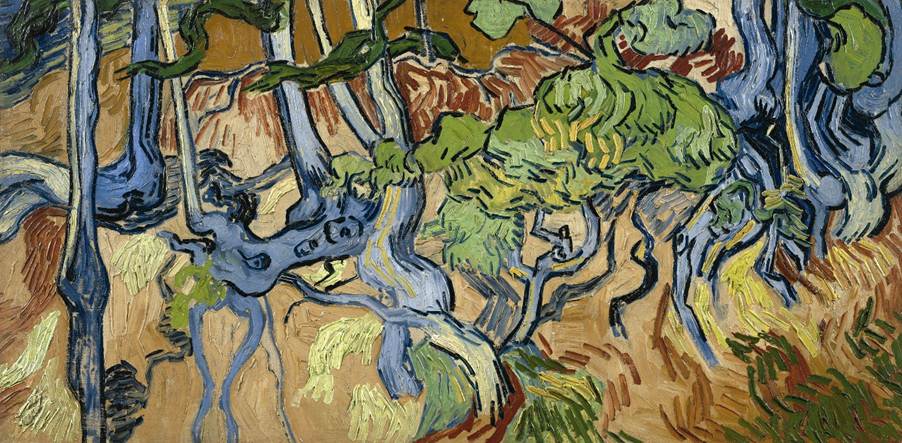
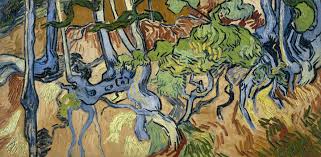
The painting you see before you is titled “Tree Roots” – a post-impressionist oil painting depicting what appears to be upturned tree with its roots exposed to the elements. This painting is one of the lesser-known works of Vincent Van Gogh, and it is largely considered to be his last painting before his untimely death. It is a well-known fact that Van Gogh struggled greatly with mental illness, that which caused him to cut off his left ear and get him hospitalized for a period of time. In the chaos of his mind, there was one thing that brought him comfort – painting. When he felt calm or well enough, he would get his brush and canvas and begin painting. It helped to give him a sense of familiarity and joy.
Art has a unique ability of allowing us to understand the way the mind of an artist works, for it can be used to represent any emotion that can be conceived by the human brain, even the ones that seem impossible to describe. Throughout history, there have been hundreds of artists whose works have allowed us to glimpse into their inner worlds. Among them, there have also been many that struggled with some form of mental illness and often used the canvas as a medium to express what was happening in their minds – a way to vent, to reflect, or even just to cope.
Another artist I’m sure you’re familiar with was Edvard Munch, the painter behind “The Scream”. This painting depicts a man standing on a bridge beneath a blood red sky. He appears to be in distress – his features are distorted and with his hands placed firmly on his cheeks, he screams. The painting in its very nature evokes anxiety. The environment appears to be in disarray; the red sky conveys a sense of dread. Furthermore, the man stands alone in this chaotic scene, safe for two men standing in the distance. The bridge stretches out far and wide, and yet no one else is there to accompany him, it’s just him and the visage of his distress as his face remains distorted along with the environment (which in and of itself could serve as a reflection of his own grief). The only other people there simply stand idly by and watch as he spills out his despair, which could invoke a sense of paranoia or loneliness within the observer
Edvard Munch struggled with anxiety and depression from a young age. The cause for this is largely speculated to be trauma he experienced from childhood; his mother, eldest sister, father and brother all passed away when he was young, and his other sister developed a form of mental illness. His first painting, “The Sick Child”, depicts what appears to be his sister lying on her death bed, looking at a grieving woman dressed in black standing next to her. With the context, it’s a very chilling work. Munch ended up painting a few other works depicting similar events. It’s clear how much his anxiety affected him. Most of his paintings are haunted by a sense of uneasiness lurking within them. “The Scream” was painted after an anxiety attack he experienced while taking a stroll in what is now called Oslo. He saw the sky turn red as the sun set and he felt a sense of dread, like nature was letting out a scream. Through his works, Munch transformed his anguish into vivid representations of human anxiety, conveying his emotions through just the way that the brushstrokes were marked on the canvas.
While Munch captured his struggles through the way in which he portrayed human figures, a different artist captured them by the way in which he portrayed cats. Louis Wain is a much lesser-known artist, but that doesn’t mean his works are any less meaningful. His struggles aren’t solely depicted in separate artworks but rather are shown with the progression of his style throughout his career. Wain’s wife at the time was discovered to be affected by breast cancer; to comfort her, he drew the one thing he knew they both loved and brought them joy and hope in their lives – cats. He had never painted cats before that, but they eventually became his favourite subject to draw. He would often draw anthropomorphized cats in mundane, everyday situations. His paintings carried some sense of whimsy within them.
However, after the death of his wife, his mental health started to decline. It is widely believed that Wain struggled with schizophrenia. Later on in his life, after the death of his pet cat and one of his sisters, his condition worsened. He started getting paranoid and at times would lash out at his loved ones, and often experienced severe psychosis. His paintings morphed into chaotic, feverish looking distorted images of cats. Full of vivid colours, jagged lines and an unsettling feel; a stark contrast from the joyful whimsy of his previous works. Wain’s works are not confirmed to have been an accurate reflection of his mental condition, but their steady progression from familiar to transfigured certainly does make one speculate.
It isn’t always possible to interpret an artist’s inner struggles with just their paintings; a good example of this instance is a renowned modernist artists named Georgia O’ Keeffe. O’ Keeffe largely painted abstractionist pieces throughout her career, mainly depicting flowers, deserts and bones, which were painted with calm, vibrant hues. O’ Keeffe wished to pursue art from a young age; however, financial hardship and difficult circumstances made this dream feel distant. On top of that, she was believed to have contracted several different illnesses throughout her life which would have proved to be a major struggle. Even when her career was thriving later in her life, she still faced numerous challenges, and the effects of those eventually caught up to her. She ended up suffering a nervous breakdown when she was around 44 years old and was hospitalized for a period of time. She would go on to experience hospitalization at many points in her life, but despite everything that was happening, art remained her way of coping with the chaos that life brought her.
O’ Keeffe’s art radiates this intrinsic sense of calm. Every aspect of her paintings from the colour choices to the way the forms appear on the canvas creates a flowing sense of harmony that soothes the observer. The brush strokes are elegantly placed, and her depictions of nature and natural objects are very reflective of their true beauty, showing how well she understood her subjects. This is reflective of her love for the countryside, where she grew up on a farm surrounded by nature. One can infer that this familiarity is likely why she picked these subjects, and why they helped her cope with her struggles.
Let’s circle back to the first painting we looked at. Van Gogh’s “Tree Roots” was painted two days before Van Gogh passed away. Van Gogh wrote in a letter to his brother that he wanted to “express something to life’s struggle,” the trees were “Frantically and fervently rooting itself, as it were, in the earth, and yet being half torn up by the storm.”, and for his final painting, it truly does convey what it was meant to. Everyone – not just artists – will experience struggle in their life; the storm will always try to rip you out from the ground and damage your roots. But if you manage to persist through the chaos, you’ll find that your own resilience becomes a form of art in and of itself. And in that sense, the very existence of these talented artist’s work is proof that even in struggle, beauty endure.