

Obsession in art - a critical analysis
Obsession in art - a critical analysis
Aditya Navin
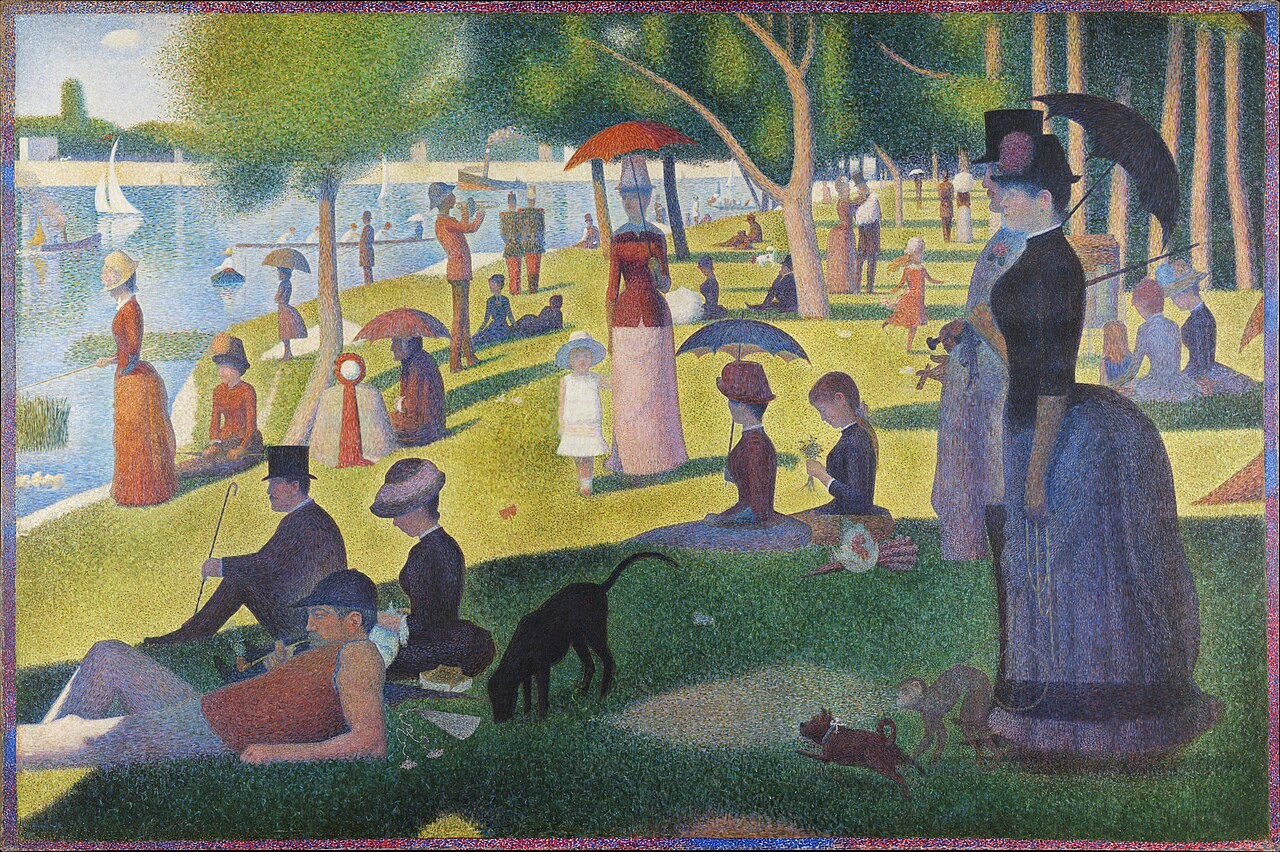
This is George’s Seurat’s A Sunday on La Grande Jatte, a monumental piece, painted over a period of 2 years, and the painting that marked the beginning of the neo-impressionist movement. The painting has a scientific foundation - by painting tiny dabs of primary colours close to each other, Seurat intensifies the viewer's perception of colours by a process of optical mixing, when colours are placed side by side, allowing the viewer to perceive a colour that is not physically present. Similar to a scientist developing a hypothesis and running test trials, roughly 30 studies and drafts were made before Seurat painted the final piece.
Seurat is a prime example of obsession in art, something that has shaped the art world for decades. Dots neatly arranged next to each other, slowly shaping a masterpiece. Brushstrokes almost mechanically applied, forming a bucolic scene of the countryside. Hundreds of paintings depicting the same subject, each portraying the subject from a a slightly different but congruous perspective.
Yayoi Kusama, one of the most prominent contemporary artists today, is a paradigmatic example of obsession in art. Renowned for her large-scale sculptures and idiosyncratic installations, particularly comprising polka dots, and regarded as a pioneer of pop art, the Japanese artist has lived of her own volition in a mental hospital since 1973. As she has struggled her whole life with panic attacks, hallucinations, and obsessive-compulsive disorder (OCD), she has labelled her art “psychosomatic”.
However, Kusama finds catharsis through her art. She creates art that represents her internal state - rooms lined with lights and mirrors that seem to stretch into infinity, and entire exhibitions filled with polka dots, the object of Kusama’s obsession - not merely the polka dots themselves but finding transcendence through them.
“Obliterate your personality with polka dots. Become one with eternity. Become part of your environment. Take off your clothes. Forget yourself. Make love. Self-destruction is the only way to peace.”
A standout artist in the world of obsession is none other than Piet Mondrian, who is regarded as one of the greatest artists of the 20th century. If Seurat’s art was scientific obsession, and Kusama’s is psychological obsession, then Mondrian’s art was a pursuit of absolutely purity and order - philosophical and even mathematical obsession. As Mondrian famously said in 1914, "Art is higher than reality and has no direct relation to reality. To approach the spiritual in art, one will make as little use as possible of reality, because reality is opposed to the spiritual. We find ourselves in the presence of an abstract art. Art should be above reality, otherwise it would have no value for man." Mondrian’s art was highly utopian - he obsessed upon idealizing a world with nearly perfect qualities and universal values. While he started as a figurative painter, he gradually developed to an abstract style, believing it could revolutionize society by bringing man, art, and the environment into a spiritual and physical balance, similar to the Catholic belief of transubstantiation.
Mondrian had an obsession with perfection in his art - other artists had rather peculiar obsessions. Salvador Dalí, for example, had a rather odd fixation with eggs. The Spanish surrealist painter, a famed eccentric renowned not only for his sophisticated surrealist art but his flamboyant public persona and distinctive moustache, was obsessed with the symbolism of the egg. The egg appears prominently in Dalínian works. For Dalí, it represented a symbol of emblematic power - due to its hard exterior and soft interior, allowing for a multitude of creative allegories.
In his work Eggs on Plate without a Plate, Dalí uses eggs to explore memories he had before birth; “The fried eggs on the plate without the plate which I saw before my birth were grandiose, phosphorescent, and very detailed in all the folds of their faintly bluish whites.
Another famous and almost hauntingly poetic example of obsession in art would be the case of Arnold Schoenberg, one of the most influential classical composers of the 21st century. Schoenberg pioneered the twelve-tone technique, also known as dodecaphony, in which all twelve notes of the chromatic scale are played in a fixed order, ensuring that no note is emphasized. Coincidentally, Schoenberg suffered from triskaidekaphobia, the fear of the number 13. Schoenberg went to the limit to avoid the number 13 in his life - he deliberately misspelled his opera Moses und Aron, as the correct spelling would have be 13 letters long.
However, the eccentricity of Schoenberg’s fear of the number 13 was miniscule compared to the circumstances of his death. Schoenberg predicted that the day of his death would be Friday 13th, July 1951. He remained the whole day in a state of anxiety: “About a quarter to twelve I looked at the clock and said to myself: another quarter of an hour and then the worst is over. Then the doctor called me. Arnold’s throat rattled twice, his heart gave a powerful beat and that was the end”. It could be dismissed simply as a coincidence - unless you add up the digits of Schoenberg’s age when he died, (76) where you’re left with 13. Scared enough?
Artistic obsession represents the most raw, unfiltered, and true side of human emotion.The obsessed create art that challenge, that evoke, that tear the heart into shreds and messily stitch it up back again - they perturb with our perception of the artist, and blur the line between insanity and creativity.